
What Are the Best Types of CNC Machines in 2026?
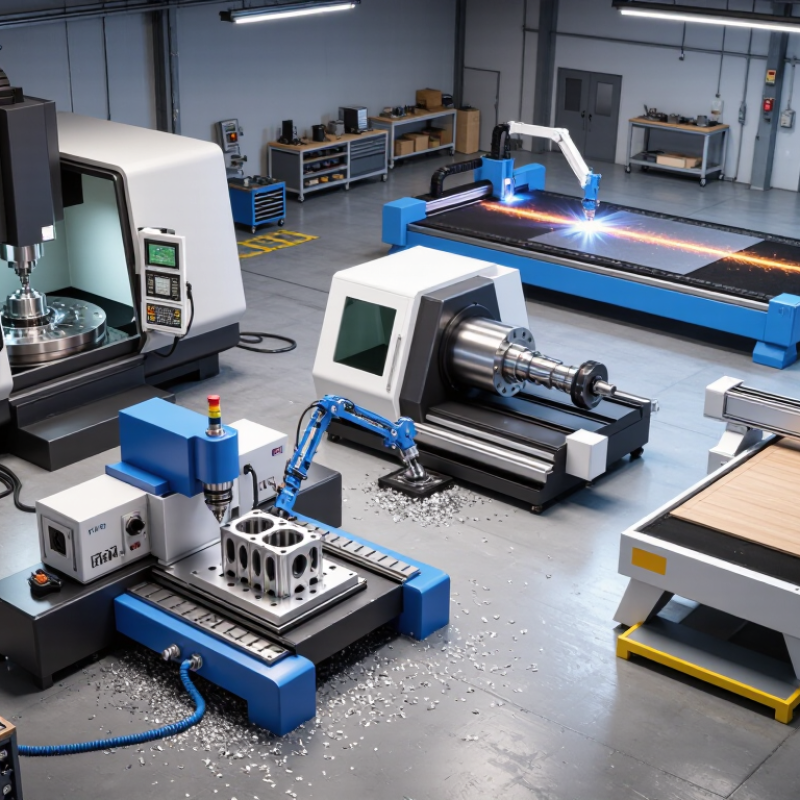
Choosing the best cnc machines in 2026 starts with the work, not the showroom floor. A compact three-axis mill can be ideal for aluminum brackets, while a five-axis machining center may handle complex contours in fewer setups. A CNC lathe suits round parts; a router can process large sheets of wood or plastic. Each machine has a place. None is best for every shop.
CNC educator and machinist John Saunders offers a useful selection principle: “Match the machine to the part, process, and production pace.” That sounds simple, but real decisions involve trade-offs. A faster spindle may not improve output if workholding, tooling, or programming becomes the bottleneck. A machine’s stated accuracy also means little without consistent setup, temperature control, and maintenance. Small details matter.
This guide compares the main CNC machine types by capability, common applications, and practical limitations. It considers mills, lathes, routers, plasma cutters, and multi-axis systems, alongside factors such as budget, floor space, materials, and operator experience. You’ll see where each type performs well—and where it can disappoint. The right choice may be less impressive on paper. That is worth thinking about. A modest machine, properly matched to repeatable work, can often outperform a costly system that sits underused.
What CNC Machines Are and How They Work
CNC means computer numerical control: a machine follows programmed instructions to move a cutting tool or workpiece. A machinist typically designs a part in computer-aided design software, then prepares toolpaths and cutting settings. The controller translates these instructions into coordinated movements along axes. A spindle may rotate an end mill, while a lathe spins the workpiece against a cutting tool. Small differences in tool condition or material can affect the finished part.
During machining, the controller directs motors, spindle speed, and tool movement. Some machines use sensors to detect position or tool changes, but they do not remove the need for careful setup. The International Federation of Robotics’ World Robotics 2024 report counted 4.28 million industrial robots operating worldwide in 2023. Robots are not CNC machines, but the figure illustrates the scale of automation surrounding modern production. That context matters.
Common CNC types include mills, lathes, routers, and plasma cutters. Mills suit rigid parts with pockets and flat faces; lathes are effective for cylindrical components. Routers often cut sheet materials, while plasma systems cut conductive metal. The “best” machine depends on geometry, material, tolerances, and production volume—not just speed. The model is tidy; real setups are less so. Clamping, tool wear, and heat can still complicate a seemingly simple job.
What Are the Best Types of CNC Machines in 2026? — What CNC Machines Are and How They Work
| CNC Machine Type | How It Works | Best Suited For | Common Materials | Key Advantages | Important Considerations |
|---|---|---|---|---|---|
| CNC Milling Machine | A rotating, multi-edge cutting tool removes material while the workpiece or tool moves along programmed axes. | Prismatic parts, pockets, slots, faces, and complex 3D features. | Aluminum, steel, stainless steel, titanium, plastics, and some composites. | Versatile; supports a broad range of geometries and operations. Three-, four-, and five-axis configurations can reach more part features with fewer setups. | Tool selection, workholding, rigidity, and cutting parameters affect surface finish and accuracy. More axes generally increase machine and programming complexity. |
| CNC Lathe or Turning Center | The workpiece rotates while a stationary or driven cutting tool removes material; some machines also include milling operations. | Round components such as shafts, bushings, pins, and threaded parts. | Aluminum, steel, stainless steel, brass, titanium, and machinable plastics. | Efficient for rotational parts and repeatable diameters. Turning centers with live tooling can complete some milled features in one setup. | Most effective when the part is primarily rotational. Part length, diameter, chuck capacity, and bar-feeding needs influence machine choice. |
| CNC Router | A high-speed spindle moves a rotating cutter through sheet or block material, commonly using a gantry-style machine layout. | Large panels, nested parts, signs, cabinetry, and lighter-duty 2D or 3D work. | Wood, plywood, MDF, plastics, foam, and some nonferrous metals when the machine is suitably rigid and equipped. | Often offers a large work area and efficient sheet processing. Well suited to routing, profiling, and engraving. | Typical routers are less rigid than metal-cutting machining centers. Cutting harder metals depends on machine construction, tooling, workholding, and operating conditions. |
| CNC Plasma Cutter | An electric arc creates a high-temperature plasma jet that melts electrically conductive material; gas flow expels the molten metal. | Fast cutting of plate, profiles, brackets, and structural components. | Conductive metals, including mild steel, stainless steel, and aluminum. | Can cut relatively thick conductive plate quickly and is effective for many fabrication tasks. | Produces a heat-affected zone and may leave dross or a tapered edge. It cannot cut electrically nonconductive materials. |
| CNC Waterjet Cutter | A high-pressure water stream, often mixed with abrasive particles for hard materials, erodes material along a programmed path. | Flat parts and profiles where heat-related material changes should be minimized. | Metals, stone, glass, ceramics, rubber, plastics, and composites, depending on setup. | Cold-cutting process with no conventional heat-affected zone; handles a wide range of materials. | Cut speed, edge quality, and operating cost depend on material and thickness. Abrasive systems require consumables and management of spent abrasive and water. |
| CNC Laser Cutter | A focused laser beam melts, vaporizes, or burns material along a programmed path, with assist gas used as appropriate. | Fast, precise sheet cutting, fine contours, and engraving. | Material capability depends on laser type: common applications include metals, wood, paper, and certain plastics. | Produces narrow cuts and supports detailed profiles with little mechanical cutting force. | Laser type and power determine what can be processed. Some materials release hazardous fumes or are unsuitable for laser cutting; extraction and safety controls are essential. |
| CNC Grinding Machine | An abrasive grinding wheel removes small amounts of material under programmed control to finish or size a workpiece. | Precision sizing, fine surface finishes, and finishing hardened components. | Hardened steels, tool steels, ceramics, and other materials suited to abrasive grinding. | Can achieve fine finishes and close dimensional control when the process and setup are appropriate. | Usually removes material more slowly than milling or turning. Wheel selection, dressing, coolant, and heat control are important. |
| CNC Wire EDM | A thin, electrically charged wire erodes conductive material through controlled electrical discharges, typically while submerged in dielectric fluid. | Intricate profiles, narrow slots, and precise cuts through conductive workpieces. | Conductive materials such as tool steel, stainless steel, copper alloys, and titanium. | Can cut complex shapes without conventional cutting forces and is useful for hard conductive materials. | Only works on electrically conductive materials. It is generally slower than sawing or milling for simple, high-volume cuts. |
| CNC Sinker EDM | A shaped electrode erodes a matching cavity in conductive workpiece material through controlled electrical discharges. | Deep cavities, mold features, and shapes that are difficult to machine with rotating tools. | Conductive metals, including tool steel and other electrically conductive alloys. | Creates complex cavities in hard materials without applying conventional cutting forces. | Requires a suitably shaped electrode and is generally limited to conductive workpieces. Electrode wear and process time should be considered. |
Related Posts
-
What Are the 10 Best CNC Machines in 2026?
-

Top Automation Machines in China for Global Buyers?
-

How to Optimize Industrial Automation for Global Suppliers?
-

How to Master Precision Engineering Techniques for Enhanced Accuracy?
-
Top 10 CNC Engraving Machines for Metal in 2026
-
Top Well Drilling Machine Tips for Efficient Purchasing Guide?