
Industrial systems often move water, air, oil, chemicals, and abrasive materials under demanding conditions. Rubber Pipe Hose offers a practical connection between fixed equipment and moving machinery. Its flexibility helps absorb vibration, reduce alignment stress, and simplify installation around crowded production lines.
Performance depends on more than rubber thickness. Engineers should check pressure ratings, temperature limits, fluid compatibility, reinforcement layers, and minimum bend radius. A hose carrying hot oil needs different construction from one handling cooling water. In a real plant, sharp edges, sunlight, dragging, and repeated bending can shorten service life. Details matter. Selecting a hose from verified technical data and reputable manufacturers supports safer, more reliable operation. Proper fittings and secure clamps matter just as much. A strong tube can still fail when the connection is poorly assembled.
This guide explores why Rubber Pipe Hose remains useful across manufacturing, construction, agriculture, and process industries. It considers flexibility, durability, maintenance, and total operating value. Field experience shows that hoses rarely fail for only one reason. Incorrect sizing, neglected inspections, or unexpected chemical exposure may all contribute. That deserves honest attention. No product is suitable for every application, and product descriptions cannot replace site-specific assessment. Users should compare manufacturer recommendations with actual working conditions, inspection records, and applicable workplace requirements. A thoughtful selection process can reduce leakage risks, unplanned downtime, and premature replacement. The goal is not simply to choose a rubber hose. It is to choose a dependable fluid-transfer solution for the equipment, environment, and workload involved.
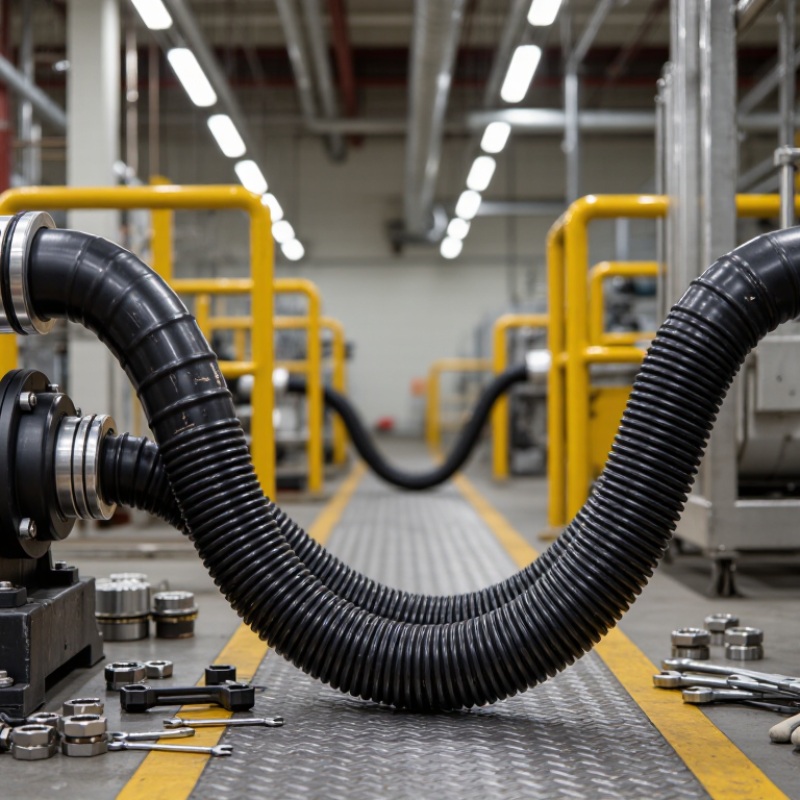
Industrial rubber hose begins with an elastomer selected for the actual service. EPDM handles hot water and weather exposure, while nitrile resists many petroleum-based fluids. Neoprene offers useful resistance to ozone and moderate chemicals. Material choice is not decorative. It determines whether the hose stays flexible beside a vibrating pump.
A hose wall usually contains an inner tube, reinforcement, and protective cover. Textile braid suits many medium-pressure duties. Spiral wire reinforcement supports higher pressure and repeated movement. The cover shields against abrasion, sunlight, and oil splashes. Small details matter. A sharp bend near the coupling can damage reinforcement before the surface looks worn.
The 4:1 burst-pressure ratio is a design reference, not permission to exceed working pressure. SAE J517 hydraulic hose requirements commonly use a minimum four-to-one burst-to-working-pressure relationship. ISO 7751 also defines pressure-testing principles for hose assemblies, including proof-pressure evaluation. For example, a hose rated at 100 bar working pressure should withstand approximately 400 bar before burst testing, subject to its specification and assembly condition. Real installations are less tidy. Heat, pulsation, aging, and poor routing reduce practical margin. Field inspection should check cracks, exposed braid, flattened sections, and leaks around fittings. Industry reports often show manufacturing and construction driving hose demand, but market growth does not replace engineering judgment. I would still verify fluid compatibility, temperature, bend radius, and coupling quality before installation.
Industrial hose selection depends on pressure, temperature, bore size, and movement. ISO 2398 classifies textile-reinforced rubber hoses for compressed air by construction and working pressure. Its published tables show that ratings vary by hose type and internal diameter. They do not support one universal pressure value. A small-bore hose may handle around 2.5 MPa, while a larger hose may require a lower rating. Check the exact table.
SAE J517 provides performance data for hydraulic hose families, including 100R1 constructions. Its pressure tables show that smaller-bore hoses can exceed 20 MPa, while larger sizes may fall below 10 MPa. These figures apply under defined test conditions. They are not permission to exceed the assembly rating. Temperature changes the decision. A hose rated at room temperature can lose pressure capacity in hot oil, near furnaces, or under continuous cycling. The actual hose specification must provide the temperature limit.
Rubber remains useful because it absorbs vibration and tolerates repeated bending. In a factory, that can mean fewer sharp load transfers at pumps and valves. Still, rubber is not automatically safer. Aging, ozone, abrasion, and poor crimping can reduce service life. ISO 2398 and SAE J517 testing improves consistency, but field inspection remains imperfect. Look for blisters, exposed reinforcement, cracking, and unusual stiffness. Replace questionable assemblies before failure, not after it.
Rubber pipe hose is chosen for more than flexibility. Its rubber compound determines how well it handles chemicals, oils, heat, and repeated pressure. A compound suited to mild water service may swell quickly in petroleum-based fluids. That change can weaken the tube from inside.
The hose cover provides another layer of protection. In busy plants, hoses drag across concrete, contact metal edges, and face sunlight, moisture, or ozone. A cover with strong abrasion resistance can slow surface damage. It cannot repair poor routing. Small cuts still deserve immediate inspection. Look for exposed reinforcement, soft spots, cracking, and unusual stiffness.
Chemical compatibility should be checked against the exact fluid, concentration, temperature, and exposure time. Oil resistance also varies between rubber types. One hose may perform well with mineral oil but fail with a different industrial fluid. This is where selection becomes less convenient. General labels are not enough.
During maintenance, I would record pressure changes, operating temperature, and visible wear. A hose that feels warmer than usual may be under abnormal stress. Bending it below its stated minimum radius can damage reinforcement, even when the cover looks clean. Abrasion resistance is useful, but it is not unlimited. Proper compound selection, reinforced construction, and realistic inspection intervals must work together. A technically suitable hose can still fail when installation conditions are ignored.
Typical suitability of common hose elastomers for industrial service. Ratings use a practical 1–5 engineering scale, where 5 indicates very strong resistance. Actual performance depends on temperature, concentration, pressure, exposure time, and hose-cover construction.
NBR is widely selected for petroleum oils and strong abrasion resistance; EPDM performs well with water-based chemicals and weathering but is generally unsuitable for petroleum oils; FKM provides excellent oil and chemical resistance at higher temperatures; CR offers balanced oil, weather, and abrasion performance. Ratings are generalized material-selection guidance aligned with commonly used resistance evaluation practices such as ISO 1817 and ASTM abrasion testing.
Rubber pipe hose works well where rigid piping cannot turn easily. Its flexible body follows machinery, walls, and narrow service corridors. This reduces the number of elbows, joints, and connection points required. Fewer joints can also mean fewer potential leak paths.
Bend radius matters more than many installers expect. A hose may look flexible, but forcing it below its rated radius can damage reinforcement layers. It may flatten, kink, or develop hidden fatigue near the fittings. In tight spaces, I measure the routing path before cutting the hose. I also leave a gentle curve near each connection. Never force a sharp turn.
Movement creates another concern. Pumps, cylinders, and vibrating equipment can shift slightly during operation. A properly routed rubber hose absorbs this movement without transferring excessive stress to equipment ports. Clamps should support the hose without crushing it. The hose should not carry the weight of nearby components. That mistake happens more often than it should.
Temperature, pressure, chemical exposure, and abrasion still require careful review. Flexible routing cannot compensate for an unsuitable hose compound. I inspect the outer cover after installation, especially near steel edges and hot surfaces. Small scuff marks deserve attention. Installation drawings are useful, but actual site conditions sometimes disagree with them. A final hands-on check remains necessary.
Rubber pipe hose handles vibration, movement, and changing temperatures better than rigid piping in many industrial settings. Its flexibility can reduce stress around pumps, valves, and machine connections. Yet flexibility does not remove risk. A damaged hose can fail suddenly under pressure.
ISO 1402 hydrostatic testing provides a controlled method for checking hose strength and assembly integrity. Technicians fill the hose with clean water and remove trapped air before pressurization. Air removal matters because compressed air can release dangerous energy during failure. Pressure should rise gradually with calibrated equipment and suitable protective barriers. No person should stand near the hose, couplings, or end fittings during the test. The test pressure and holding time must follow the applicable specification and hose requirements.
Inspectors should watch for leaks, abnormal swelling, cover separation, coupling movement, and permanent deformation. They should record the hose identification, test pressure, gauge details, duration, and observations. Maintenance continues after testing. Check for cuts, hardening, blistering, exposed reinforcement, crushed sections, and corroded fittings. Store hoses away from heat, sunlight, chemicals, and sharp edges. Small details matter.
A passing test does not guarantee safe service forever. Installation errors, repeated bending, and chemical exposure can shorten hose life. Field teams should review failures honestly, even when the test result looked acceptable. That reflection often reveals poor routing or neglected inspections.
Arsun Engineers is the well-known manufacturer, exporter, and supplier of highly operational machines.