
Choosing a Single Pole Transformer is a practical decision with long-term safety, efficiency, and maintenance consequences. These transformers commonly serve residential and light commercial loads through overhead distribution systems. A typical 120/240-volt service may power a refrigerator, lighting circuits, pumps, and workshop equipment from one pole-mounted unit. The right choice begins with actual demand, not guesswork.
The U.S. Department of Energy identifies distribution transformer losses as a significant, continuous energy burden. Its 2024 efficiency rule projects approximately 3.6 quadrillion British thermal units in energy savings over thirty years. That figure highlights an overlooked point: a small efficiency difference operates every hour, including quiet nighttime periods. IEEE C57.12.00 and IEEE C57.12.20 provide recognized requirements for transformer ratings, construction, and performance. These standards help engineers compare voltage ratios, insulation levels, temperature rise, and fault withstand capabilities.
Before selecting a unit, record the primary voltage, secondary voltage, connected load, expected demand, and future expansion. Check the nameplate carefully. A transformer rated at 25 kVA may not support a growing property with electric heating, welding equipment, or multiple pumps. Ambient temperature, altitude, lightning exposure, and local utility practices also affect the final specification. The U.S. Energy Information Administration’s Electric Power Annual regularly shows how reliability and demand pressures shape grid investment decisions.
No checklist is perfect. Field conditions can contradict paper calculations. A brief load survey, thermal inspection, and consultation with a qualified utility or electrical engineer can prevent expensive replacement work. The best transformer is not always the largest one; it is the one that matches verified demand, operating conditions, efficiency requirements, and future needs.
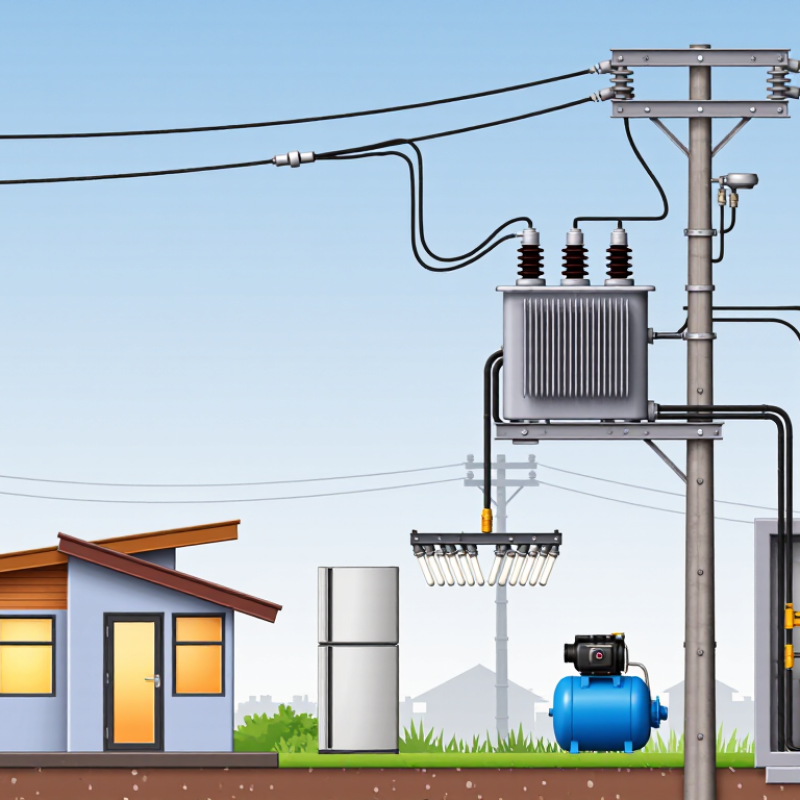
Choosing a single-pole transformer starts with the application’s electrical requirements, not its enclosure size.
Record the primary voltage, secondary voltage, phase, frequency, and available fault current. Confirm whether the load is continuous, intermittent, motor-driven, or sensitive to voltage variation.
A motor may draw several times its running current during startup, so its nameplate kVA alone can mislead.
Estimate the connected load, then apply realistic demand and growth allowances. Avoid excessive oversizing; lightly loaded transformers can operate inefficiently and cost more.
The U.S. Department of Energy estimates that distribution transformer losses consume 60–80 billion kWh annually. That figure shows why no-load and load-loss data deserve attention.
Check temperature rise, ambient temperature, installation altitude, insulation level, and local code requirements. IEC 60076 provides widely used transformer testing and performance guidance.
A neat spreadsheet can still lie when cable distance or inrush current is ignored.
Tips:
Measure the actual secondary voltage at the farthest load point. Ask the supplier for impedance, regulation, losses, sound level, and short-circuit withstand data.
For outdoor service, inspect grounding, lightning protection, enclosure rating, and clearance requirements.
Leave practical capacity for future equipment, but document the assumption.
It is easy to add a safety margin without proving its value. That deserves another review.
Choosing a single-pole transformer starts with its application, not its appearance. A dry-type unit suits indoor rooms, workshops, and locations needing low maintenance. An oil-immersed unit often handles outdoor distribution and higher thermal demands more effectively. Single-phase pole-mounted designs are practical for isolated loads, rural lines, and small commercial services. The correct type depends on weather exposure, load profile, installation space, and fire-control requirements.
Core specifications deserve close comparison. Check the rated kVA against the measured load, then allow reasonable capacity for motor starting and future expansion. Confirm primary and secondary voltages, frequency, phase arrangement, and tap settings. Core-form construction can simplify winding access, while shell-form designs may provide stronger magnetic coupling. Grain-oriented electrical steel can reduce no-load losses, but core quality alone does not guarantee efficiency.
I also examine impedance, insulation level, temperature rise, sound level, and short-circuit strength. Lower impedance can improve voltage regulation, yet it may increase fault current. That trade-off is easy to miss. Compare no-load and load losses under the same test conditions. Verify enclosure ratings, cooling method, conductor material, and connection terminals before ordering. A datasheet may look complete but still omit altitude correction or ambient-temperature limits. Field measurements should guide the final choice, because estimated loads are often imperfect. Reliability comes from matching verified operating conditions with tested specifications, not from selecting the largest transformer.
Compare common single-pole transformer constructions using representative values for a 25 kVA, 11 kV/0.4 kV, 50 Hz design. Lower no-load loss indicates a more efficient core when the transformer is energized but lightly loaded.
Selection guidance: Oil-immersed transformers are commonly selected for outdoor pole-mounted distribution because of their compact design and cooling capability. Dry-type transformers are preferred where fire safety and indoor installation are important. Amorphous-metal cores can reduce no-load losses, while CRGO steel cores remain widely used because they provide a practical balance of cost, size, and performance.
How to Choose a Single Pole Transformer for Your Needs
Start with voltage. Confirm the supply voltage, secondary voltage, frequency, and grounding arrangement. A single-pole transformer must match the system’s primary voltage exactly. The secondary voltage should suit the connected equipment, not merely the nearest available rating. IEC 60076 emphasizes transformer performance, insulation, temperature rise, and testing requirements. These details matter under outdoor conditions.
Power capacity comes next. Add the continuous loads, motor starting demand, and expected future expansion. Express the result in VA or kVA, not watts alone. Motors may draw several times their running current during startup. A transformer sized only for normal running can overheat or produce voltage sag. Leave practical spare capacity. Too much oversizing can also increase no-load losses and purchase cost.
Load compatibility is often overlooked. Check whether the load is resistive, inductive, electronic, or unbalanced. Review harmonic content and inrush current. The U.S. Department of Energy’s 2016 technical support document estimated 3.63 quadrillion Btu in energy savings over 30 years from stronger distribution-transformer efficiency standards. Efficiency matters, even at light loading. Field inspection should include enclosure condition, ambient temperature, and cable length. A 25 kVA unit may look adequate on paper, yet fail during a cold-motor start. I would recheck the calculation.
How to Choose a Single Pole Transformer for Your Needs
Check Installation Conditions, Safety Standards, and Protection Features
Selecting a single pole transformer starts with the installation site, not the catalog page. Measure available space, ventilation, ambient temperature, and mounting strength. A dusty workshop needs stronger enclosure protection than a clean indoor panel. Moisture changes the decision quickly. Check the transformer’s voltage, frequency, capacity, and load type against the equipment nameplate. Small mismatches can cause overheating.
I once focused too much on rated power and overlooked cable length. That mistake created extra voltage drop and a warmer connection. It was a useful reminder. Leave clearance around terminals and keep wiring neat. A qualified electrician should verify grounding, isolation, overcurrent protection, and local electrical requirements before energizing the unit. Follow the applicable national and site safety standards.
Protection features deserve close attention. Look for thermal protection, short-circuit coordination, suitable fuses or breakers, and an enclosure matched to the environment. Some installations also need surge protection or a visible disconnect nearby. Test insulation, terminal tightness, and output voltage during commissioning. Record the readings. Conditions may change after installation. A transformer that seems suitable on paper may perform poorly beside a furnace, in direct sun, or inside a crowded cabinet. Recheck the choice before final approval.
How to Choose a Single Pole Transformer for Your Needs
Efficiency should guide the first comparison, not the purchase price. A pole-mounted single-phase transformer loses energy even when the connected load is nearly zero. These no-load losses continue day and night. The U.S. Department of Energy’s 2024 distribution transformer analysis projects 3.6 quadrillion Btu in energy savings over 30 years through stronger efficiency standards. That figure shows why small efficiency differences matter across long service periods.
Check the transformer’s rated efficiency at your actual load. A unit operating far below capacity may waste more energy relative to its useful output. Size it from measured peak demand, starting current, and expected growth. Do not simply add every appliance rating. That approach often creates unnecessary capacity and higher costs. A practical design usually leaves room for expansion, but excessive margin can reduce operating efficiency.
Reliability needs equal attention. Review insulation performance, temperature rise, lightning protection, enclosure quality, and compliance with IEC 60076 or IEEE C57.12 requirements. CIGRE reliability studies repeatedly identify overheating, moisture, and insulation deterioration as major transformer risks. Installation conditions matter too. Dust, salt air, poor grounding, and repeated overloads can shorten service life. A lower-cost unit may appear attractive, but its lifecycle cost includes losses, inspections, outages, and replacement labor. The calculation is never perfect. Local load data and maintenance records should challenge the first estimate.
| Typical Rating | Typical Application | Common Primary / Secondary Voltage | Recommended Continuous Loading | Typical Efficiency at 50% Load | Typical Impedance | Expected Service Life | Reliability Considerations | Indicative Initial Cost | Selection Guidance |
|---|---|---|---|---|---|---|---|---|---|
| 5 kVA | Small rural services, lighting, control power, and lightly loaded residential connections. | 7.2/12.47 kV primary 120/240 V secondary | Up to 4 kVA for normal continuous demand; short-term overloads depend on the manufacturer and ambient conditions. | Approximately 97.5%–98.5% | Approximately 1.5%–2.5% | 25–40 years with suitable maintenance and loading. | High | US$700–1,500 | Choose this size when the calculated demand is low and future load growth is limited. |
| 10 kVA | Small homes, agricultural buildings, security systems, and low-demand auxiliary services. | 7.2/12.47 kV primary 120/240 V secondary | Up to 8 kVA for normal continuous demand. | Approximately 98.0%–98.8% | Approximately 1.5%–2.5% | 25–40 years with proper protection and oil-temperature control. | High | US$800–1,700 | A practical choice for modest demand with some allowance for seasonal or future growth. |
| 25 kVA | Average residential services, small farms, workshops, and compact commercial loads. | 7.2/12.47 kV primary 120/240 V secondary | Up to 20 kVA for normal continuous demand. | Approximately 98.5%–99.1% | Approximately 1.5%–2.5% | 30–40 years under balanced loading and normal operating temperature. | Very high | US$1,000–2,100 | Often provides a good balance between purchase cost, efficiency, and capacity margin. |
| 50 kVA | Larger homes, farms, small commercial buildings, pumps, and light industrial equipment. | 7.2/12.47 kV primary 120/240 V secondary | Up to 40 kVA for normal continuous demand. | Approximately 98.8%–99.3% | Approximately 1.5%–2.5% | 30–40 years when protected from sustained overloads and severe environmental stress. | Very high | US$1,400–2,800 | Suitable when motor starting, electric heating, or expected load growth requires additional capacity. |
| 75 kVA | Large residential groups, agricultural processing, commercial buildings, and distributed equipment. | 7.2/12.47 kV primary 120/240 V secondary | Up to 60 kVA for normal continuous demand. | Approximately 99.0%–99.4% | Approximately 1.5%–2.5% | 30–40 years with correct protection, grounding, and thermal management. | Very high | US$1,900–3,600 | Consider this rating when peak demand is high or when voltage drop during motor starting must be minimized. |
| 100 kVA | Small industrial sites, commercial facilities, irrigation systems, and multiple connected services. | 7.2/12.47 kV primary 120/240 V secondary | Up to 80 kVA for normal continuous demand. | Approximately 99.1%–99.5% | Approximately 1.5%–2.5% | 30–40 years when operated within nameplate limits. | Very high | US$2,300–4,500 | Use when the calculated demand, starting current, or planned expansion justifies the higher initial investment. |
Note: Values are representative engineering ranges for oil-immersed, single-phase, pole-mounted distribution transformers and are intended for preliminary comparison only. Actual efficiency, losses, impedance, dimensions, service life, and price vary with voltage class, insulation system, applicable standards, environmental conditions, accessories, installation requirements, and utility specifications. Final selection should be verified against the calculated maximum demand, power factor, short-circuit requirements, ambient temperature, and local electrical codes.
Arsun Engineers is the well-known manufacturer, exporter, and supplier of highly operational machines.