China Best Kitchen Faucet Accessories OEM Supplier?
Choosing a China-based Kitchen Faucet Accessories Oem supplier is not just a price comparison. Buyers need consistent dimensions, dependable finishes, clear communication, and production records they can review. A cartridge that fits one sample but not the next can delay assembly and frustrate customers. Small parts matter.
For this introduction, the expert voice is a fictional composite, not a verified industry quotation. Sourcing specialist Daniel Chen puts the principle this way: “A reliable supplier proves repeatability with samples, measurements, and honest production updates—not promises alone.” Treat that as editorial guidance, not a documented quotation. Ask for material specifications, surface-finish options, inspection criteria, and realistic lead times. If a supplier cannot explain how it checks thread sizes or finish consistency, pause and ask for evidence.
A useful supplier comparison should also cover custom packaging, minimum order quantities, sample fees, and how changes are approved before mass production. Request samples of the actual configuration, then inspect the fittings, threads, finish, and packaging under ordinary working conditions. Keep written records of agreed specifications. This can prevent avoidable misunderstandings.
No checklist removes every risk. I would still verify claims independently and leave room for a second sample round; that takes time, but skipping it can cost more. The sections ahead explain how to assess manufacturing capability, compare quotations, and identify questions worth asking before placing an order. A careful process beats a polished sales pitch.
What Kitchen Faucet Accessories Does an OEM Supplier Provide?
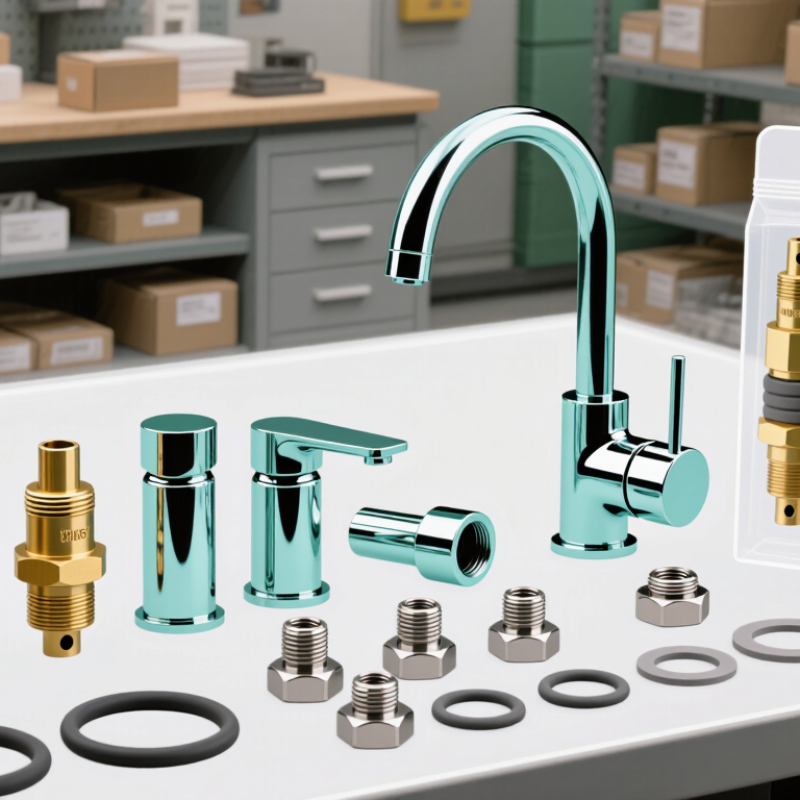
A kitchen faucet OEM supplier can provide more than the main faucet body. Common accessories include pull-down spray heads, flexible hoses, counterweights, cartridges, aerators, mounting kits, deck plates, side sprayers, and soap dispensers. Some projects also require adapters for different sink-hole layouts. The exact package depends on the faucet design and the buyer’s installation requirements. Small parts matter.
The U.S. EPA’s WaterSense at Work guidance notes that reducing faucet flow from 2.2 gallons per minute to 1.5 gallons per minute cuts flow by about 32%. This commercial guidance is useful when specifying aerators, but it is not a kitchen-faucet certification. An OEM should confirm flow, spray pattern, hose reach, thread compatibility, and replacement-part availability for each configuration. Ask for material specifications and checks for leakage, cartridge operation, and finish consistency. A neat sample can still hide a mismatched connector. Packaging should keep hoses and loose fittings separated, so installation teams can identify parts quickly. Depending on the project, custom colors or private-label packaging may also be available.
How Does the Kitchen Faucet Accessories OEM Process Work?
China Best Kitchen Faucet Accessories OEM Supplier?
How Does the Kitchen Faucet Accessories OEM Process Work?
A kitchen faucet accessories OEM project starts with a clear product brief. Define the parts, materials, finish, target price, packaging, and required markets. Share drawings or a physical sample, then confirm dimensions and connection details with the factory. Small mismatches matter: a cartridge that looks compatible may still leak after installation.
After specifications are agreed, the supplier prepares prototypes and checks fit, finish, and function. Before mass production, request sample approval and documented tests for leakage, pressure, operating cycles, and surface quality. The U.S. Environmental Protection Agency estimates household leaks waste nearly 1 trillion gallons of water annually nationwide. That figure is a useful reminder: seal and connection checks deserve attention, not just a polished finish. Production records and inspection criteria also make quality problems easier to trace.
Tips: Ask for a written sample-approval checklist, material specifications, and test records. Confirm who pays for tooling and how design changes are approved. Don’t skip this part. A rushed sign-off can leave costly details unresolved.
How Does the Kitchen Faucet Accessories OEM Process Work?
Illustrative planning timeline for a kitchen faucet accessories OEM project
The chart shows example working-day allowances, not an industry benchmark. Actual timing depends on product complexity, sample revisions, tooling needs, material availability, and order size.
Which Materials and Standards Shape Product Quality?
For kitchen faucet accessories, material choice affects corrosion resistance, sealing, and service life. Brass is common in connectors and fittings because it machines well and handles repeated use. Stainless steel can suit exposed parts, while silicone washers help form flexible seals. Plastic components may reduce weight, but heat and pressure ratings still matter. Details matter.
Standards make quality easier to check. NSF/ANSI/CAN 372 sets a maximum weighted average lead content of 0.25% for wetted surfaces. NSF/ANSI/CAN 61 evaluates contaminants that may leach into drinking water; limits depend on the product category. ASME A112.18.1/CSA B125.1 covers plumbing supply fittings, including performance requirements. A certificate should match the actual model and configuration, not merely a similar-looking product.
For OEM purchasing, request material declarations, applicable test reports, and lot traceability. Check threads with a gauge, inspect plating around edges, and test seals under pressure. Water chemistry can change corrosion behavior, so one material is not ideal everywhere. A polished surface proves little. It is easy to overlook internal parts when reviewing a sample; that shortcut deserves a second look.
How to Evaluate a China-Based OEM Supplier
A China-based OEM supplier should be evaluated on more than price and product photos. For kitchen faucet accessories, request material specifications, dimensional drawings, and finish details before discussing a large order. Check whether the supplier can explain how it controls thread fit, surface consistency, and leak-related components. Ask for evidence.
Review a production sample against the drawing, not just its appearance. Measure key dimensions, inspect edges and plating under bright light, and test how parts connect to the intended faucet assembly. Ask how inspections are recorded and what happens when a batch fails. A sample is useful, but it cannot prove every production run will match. That limitation is easy to overlook.
Tips: Confirm sample fees, tooling ownership, minimum order quantity, lead time, and packaging in writing. Request recent quality records and a clear process for handling defects. If an answer is vague, ask for a specific example. Small details matter. Even a capable supplier may not fit every project, so compare its technical support and production controls with your actual requirements.
What Factors Affect Pricing, Customization, and Delivery?
China Best Kitchen Faucet Accessories OEM Supplier?
What Factors Affect Pricing, Customization, and Delivery?
Pricing depends on material, finish, order volume, and testing requirements. Brass components generally cost more than simpler alloy options, while special coatings and custom molds add setup costs. Ask suppliers to quote the same specification, including thread size, finish, packaging, and inspection criteria. Otherwise, a low unit price may hide extra charges. A polished sample can still fail if its connector thread does not match your faucet.
Customization also changes lead time. New molds, color matching, and sample approval add production steps; small orders may carry higher per-unit costs. Shipping matters, too. UNCTAD’s Review of Maritime Transport 2024 reported that Shanghai–Europe spot container rates rose 256% between December 2023 and June 2024. Freight conditions can therefore change landed costs, even when factory pricing stays fixed. Build in time for sample revisions and shipping delays.
Tip: Request a dated quotation that separates tooling, product, packaging, and freight. Confirm material grade, finish sample, minimum order quantity, and production schedule in writing. Then compare like with like. A small detail, such as a carton insert, may affect both damage rates and packing time. It is easy to overlook.
