
Choosing the best Deck Boards starts with a practical question: what must the surface handle? A shaded backyard with wet leaves has different needs from a sun-baked rooftop deck. Pressure-treated wood, cedar, composite, and PVC each balance cost, upkeep, appearance, and resistance to moisture differently. No board wins everywhere. Even a premium product can disappoint if its framing, drainage, or installation is poor.
Industry figures offer useful context, but they need careful reading. Zonda’s 2024 Cost vs. Value report, published by Journal of Light Construction, estimates a national average cost of $17,615 for a wood deck addition, with $14,596 in resale value recovered, or 82.9%. Its composite deck addition estimate is $24,206, with $16,498 recovered, or 68.2%. These figures compare whole projects, not board prices or lifetime maintenance costs. They also reflect national averages, not every local climate or contractor quote. That distinction matters.
For homeowners, the real comparison includes more than the checkout price. Think about fading beneath a patio chair, splinters on bare feet, and how often boards need cleaning or refinishing. Manufacturer warranties and published care instructions can help, but they do not replace checking the product’s installation requirements. I would not treat any single report as a final verdict. The best choice depends on budget, climate, intended use, and willingness to maintain the deck—details that are easy to underestimate.
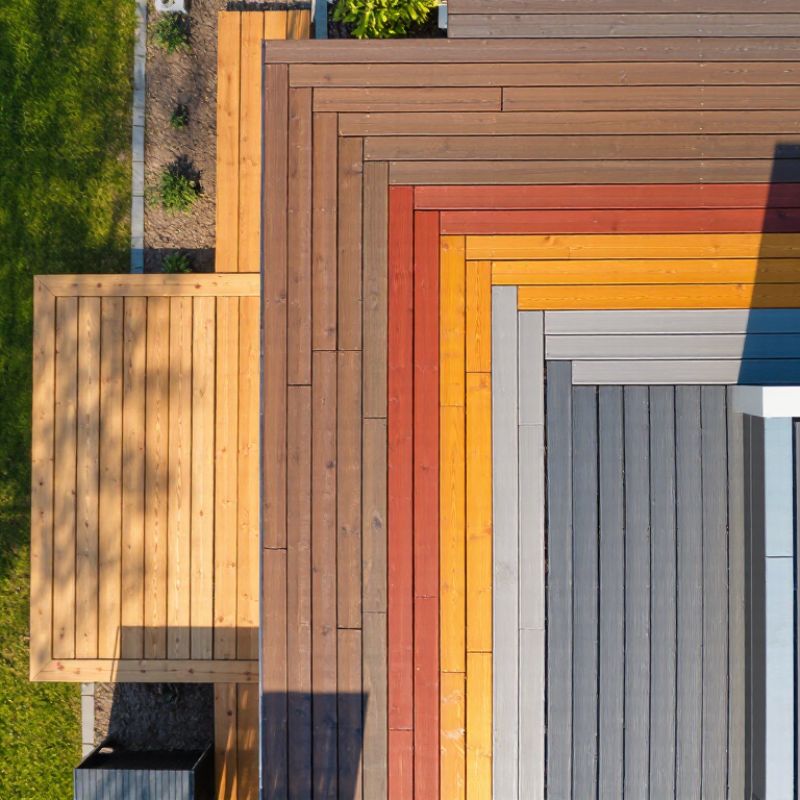
“Best” depends on how the deck will be used. For strength, compare board thickness, joist spacing, and published span guidance, not just material names. Wood can handle substantial loads when properly supported, but it may split or warp as it dries. Composite boards resist many moisture-related problems, yet they can feel flexible if the framing is too widely spaced. Check the installation requirements before choosing. Small details matter.
Slip resistance is easiest to judge with a real sample. Wet the surface and walk across it carefully in the shoes you normally wear outside. Texture may help, but dirt, leaves, and algae can still make a deck slippery. Heat is another practical test. Dark boards in direct afternoon sun can become uncomfortable under bare feet; lighter colors often stay cooler, though shade and airflow also matter. Feel it barefoot, but do not treat one sunny-day test as a guarantee.
Compare the full service life, not only the checkout price. Wood often costs less initially, but cleaning, sealing, and replacing damaged boards add time and expense. Composite usually costs more upfront and needs less routine coating, but it is not maintenance-free. Hose it down, and check its surface-care instructions. Costs and durability vary by climate and installation quality. I would not pretend one board wins everywhere; even careful estimates can miss how much sun, water, or foot traffic a particular deck receives.
Deck boards differ most in what they ask of you after installation. Wood feels warm underfoot and can be cut or repaired with familiar tools. But sunlight and rain gradually fade, swell, and roughen exposed boards. The USDA Forest Products Laboratory’s Wood Handbook explains that moisture changes can cause wood to shrink and swell. Expect periodic cleaning, inspection, and protective coating; the schedule depends on local weather and exposure. Small details matter. A shaded, dry deck usually ages differently from one facing harsh afternoon sun.
Capped composite pairs a wood-plastic core with a protective polymer shell. It resists routine staining and splintering, though dirt still needs washing and scratches may be difficult to hide. PVC boards contain no wood fibers, so they avoid wood-related rot, but their appearance and feel differ from natural lumber. No option is maintenance-free. Remodeling magazine’s 2024 Cost vs. Value report estimated a national average of $17,615 for a wood deck addition and $25,096 for a composite one. Those figures describe project costs, not lifetime upkeep, so they should not be treated as a full ownership comparison. I would not choose by price alone: heat, shade, board texture, and willingness to refinish can change the better fit. A little uncertainty remains. That is normal.
What Is the Best Type of Deck Board?
The best deck board is not simply the one that looks strongest. Check its ASTM D7032 performance information, then compare the manufacturer’s joist-span limits for that exact board. ASTM D7032 sets performance criteria for wood-plastic composite decking and guardrail systems. A rating can help you assess documented performance, but it does not provide one universal spacing rule. Board thickness, profile, installation direction, and expected loads all matter. Small details count.
Tips: Find the span table for the exact product and board profile. Confirm whether it covers residential use and the load conditions for your project. A board listed for 16-inch joist spacing may require closer supports when installed diagonally. Do not guess. If a test report and installation guide seem inconsistent, ask the manufacturer or a qualified deck professional for clarification before building.
Measure joist spacing from center to center, and follow the stated limit rather than relying on appearance. Also check local building requirements, since they may set additional conditions. The comparison can feel fussy. It is still worth doing; a stiff sample in a showroom cannot tell you how a full deck will perform across widely spaced joists.
| Deck-board type | ASTM D7032 relevance | Joist-spacing guidance | Key advantages | Important checks |
|---|---|---|---|---|
| Pressure-treated wood | D7032 is for wood-plastic composite deck boards and guardrail systems, not a general rating standard for solid wood lumber. | Use the lumber grade, board dimensions, local code, and deck design to set spacing. Do not assume one spacing works for every board or layout. | Widely available; can be cut and fastened with standard woodworking tools. | Check the lumber grade and treatment-use label. Follow applicable requirements for cutting, fastening, and ground clearance. |
| Cedar or redwood | D7032 does not provide a general performance rating for solid wood boards. | Determine spacing from the board’s species, grade, thickness, orientation, and applicable design requirements. | Natural wood appearance; boards can be cut and worked with common tools. | Inspect for grade and defects, and plan for weathering and periodic maintenance. |
| Wood-plastic composite (WPC) | ASTM D7032 covers performance ratings for WPC deck boards and guardrail systems. It is not a universal numerical “grade”; check the specific product’s documented evaluation and allowable design values. | Use the product’s installation guide. A 16 in. on-center layout is common for many products installed perpendicular to joists, but it is not a universal limit; diagonal layouts or particular products may require closer spacing. | Typically needs less routine surface treatment than unfinished wood; available in a range of colors and profiles. | Confirm allowable joist spacing, board orientation, fastening method, end-to-end support, and any stair or overhang limits in the product-specific instructions. |
| Capped WPC | The WPC core falls within the subject area of D7032; verify the exact product’s documented compliance and performance information. | Follow the exact product’s span table. Common spacing patterns are not a substitute for the manufacturer’s limits, especially for diagonal installations. | A protective cap is designed to help shield the composite core from surface exposure. | Check required gaps, clips or screws, cut-edge instructions, ventilation, and approved cleaning methods. |
| Cellular PVC | ASTM D7032 is specifically for WPC products; do not assume it applies to a cellular PVC board. Ask for the applicable evaluation and product-specific structural data. | Use the published span table for the exact board and installation. Spacing depends on the product, orientation, and intended use. | PVC-based boards do not contain wood fibers and are designed for outdoor use. | Check temperature-related movement, fastening requirements, ventilation, and any limits for stairs or unsupported ends. |
| Tropical hardwood | D7032 does not provide a general performance rating for solid hardwood lumber. | Base spacing on the species, board dimensions and grade, fastening system, and applicable design requirements. | Dense natural wood with a distinctive appearance. | Confirm species identification, sourcing documentation, pre-drilling and fastening guidance, and maintenance needs. |
How to choose: There is no single best board for every deck. For WPC, request the applicable ASTM D7032 documentation and check the exact product’s joist-span table. Confirm whether spacing is measured on center, whether the boards run perpendicular or diagonally to the joists, and whether separate limits apply to stairs, picture frames, or overhangs. Follow local building codes and the product’s current installation instructions.
Installed price can change the “best” deck board before the first joist is checked. In many U.S. markets, pressure-treated lumber runs about $15–$25 per square foot installed, while cedar often costs $25–$40. Composite commonly falls around $30–$60, and PVC can reach $40–$70. Local labor, stairs, and demolition can shift those figures sharply. Get quotes for the same deck dimensions and scope.
Published warranty duration offers another comparison, but the number alone can mislead. Natural wood often has limited coverage for product defects; pressure-treated lumber may include longer decay coverage, depending on treatment and terms. Composite warranties commonly range from 25 to 50 years, while some PVC products advertise coverage up to 50 years. Read the exclusions. Color change, surface wear, installation errors, and improper cleaning may be treated differently.
A warranty is not a lifespan promise. Not even close. On a sunny deck, a dark board can become hot under bare feet, while a shaded corner may stay damp after rain. I would compare the installed cost with the exact covered risks, then check whether required upkeep fits your routine. Honestly, warranty wording can be harder to compare than board prices. Ask the installer to identify who handles a claim and what maintenance records you must keep.
Compare estimated installed cost with commonly published limited-warranty durations.
Composite and PVC boards generally have higher estimated installed costs, while their published limited warranties are often longer. The chart plots the midpoint of each range; actual costs depend on location, design, framing, and labor, and warranty terms vary by product and may include exclusions.
U.S. planning estimates per square foot, including installation: pressure-treated wood $15–$25; cedar $25–$35; composite $30–$50; PVC $40–$60. Typical published limited-warranty ranges shown for comparison: pressure-treated wood 10–15 years; cedar 10–25 years; composite 25–50 years; PVC 25–50 years. Verify current local pricing and the specific product warranty before purchasing.
Deck boards should suit the weather they will actually face. In humid or rainy regions, persistent dampness can make untreated wood more vulnerable to decay. The USDA Forest Products Laboratory’s Wood Handbook notes that decay fungi generally need wood moisture content above about 20 percent. That is a useful warning, not a guarantee: shade, drainage, and airflow also affect how quickly boards dry. Water always wins.
In sunny, hot climates, boards can become uncomfortable underfoot and may fade or move as temperatures change. Composite and plastic boards often need less routine coating, but their heat retention and expansion vary by formulation. Check the product’s temperature and spacing guidance before installation. I would not treat “low maintenance” as “no maintenance.” Dirt still collects between boards.
Building codes matter as much as climate. The 2021 International Residential Code lists a 40-pound-per-square-foot live load for decks in its prescriptive table; locally adopted editions and amendments may differ. Confirm requirements with the local building department, especially for elevated decks, unusual spans, or heavy planters. Then match upkeep to your habits: wood may need periodic sealing, while any deck benefits from clearing leaves and checking fasteners. Inspect after winter, too. A slightly warped board is easy to overlook until it holds water beside the house.
Arsun Engineers is the well-known manufacturer, exporter, and supplier of highly operational machines.