Top 51.2V 160Ah LFP Batteries for Solar Storage
Choosing among the Top 51.2V 160Ah LFP Batteries for Solar Storage means looking beyond capacity labels. The keyword 51.2 V 160ah Lfp Batteries describes a common lithium iron phosphate battery class for home and off-grid systems. At nominal voltage, 160 amp-hours represents about 8.2 kilowatt-hours of stored energy. Usable energy can be lower. The battery’s protection settings, inverter compatibility, and operating temperature all matter.
Battery scientist Dr. Yet-Ming Chiang’s work supports a practical principle, paraphrased here: “Judge storage by how reliably it serves its real operating needs.” That is more useful than chasing a headline specification. A careful comparison should check the battery management system, continuous charge and discharge limits, warranty terms, and published cycle-life conditions. Also confirm whether the unit can communicate with your inverter. Two batteries with similar ratings may behave differently under real loads.
Picture a refrigerator running through a cloudy afternoon, with evening lights drawing power later. Those details shape the right system size. Still, a large capacity number can mislead. It does not tell you how much energy remains available after reserve settings, conversion losses, or aging. Product documentation is not always easy to compare, and that deserves attention. This guide examines leading options, their practical strengths, and the questions to ask before choosing one for solar storage.
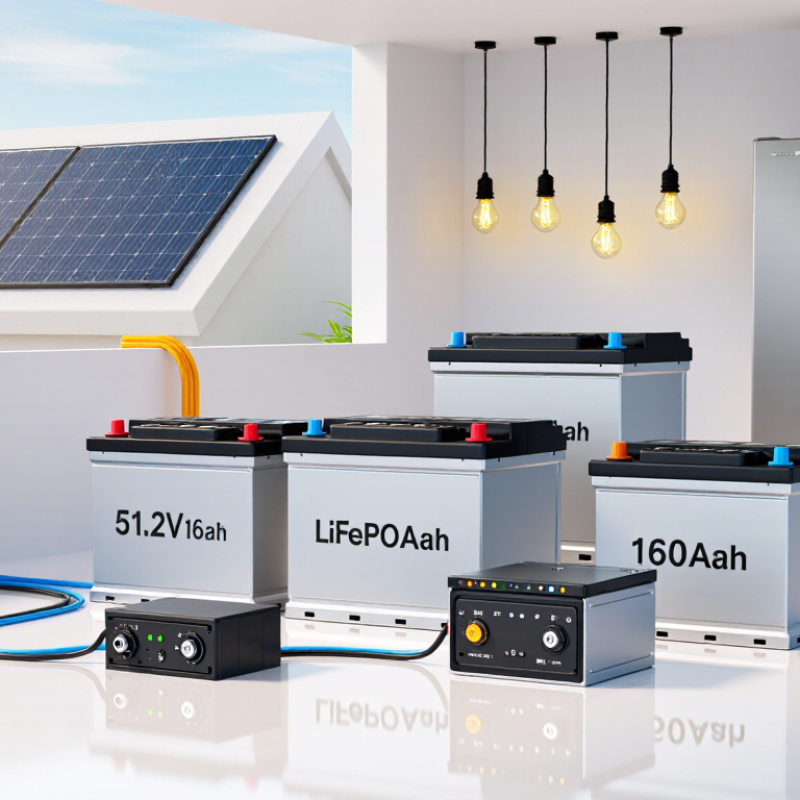
2 V × 160 Ah: 8.19 kWh Nominal Energy and LFP Chemistry
A 51.2 V, 160 Ah LFP battery stores about 8.19 kWh of nominal energy. The calculation is straightforward: 51.2 volts multiplied by 160 amp-hours equals 8,192 watt-hours. A label stating “2 V × 160 Ah” would not describe this battery correctly; at 2 volts, the nominal energy would be only 0.32 kWh. Check the voltage specification before comparing systems.
Nominal energy is not the same as energy available to household loads. The battery management system, inverter efficiency, temperature, and permitted discharge limit all affect usable capacity. Real conditions matter. For example, a home using 1 kW continuously could theoretically draw power for just over eight hours, but actual runtime will be shorter. Solar output also changes with cloud cover and season, so battery sizing should reflect measured daily consumption rather than a best-case estimate. It is easy to overestimate autonomy by dividing capacity by one appliance’s rating and ignoring overnight background loads. A refrigerator, network equipment, and standby electronics keep drawing power. Check that the battery’s voltage and current limits match the inverter, and allow ventilation and service access during installation. A little extra capacity can help, though it cannot compensate for a mismatched system.
At 80% Depth of Discharge, 8.19 kWh Provides About 6.55 kWh
A 51.2 V, 160 Ah battery stores 8.192 kWh at its nominal rating. At 80% depth of discharge, the arithmetic is straightforward: 8.192 × 0.80 = 6.55 kWh. The remaining 20% is held back under that operating limit; it is not part of the planned discharge. That matters. For a home using about 1 kWh each evening for lights, a refrigerator, and a router, 6.55 kWh represents roughly six such evenings on paper.
It is a planning estimate, not a guaranteed amount at the outlets. Inverter conversion, temperature, battery age, and the battery management system’s reserve can reduce delivered energy. NREL’s 2024 Annual Technology Baseline uses about 85% round-trip efficiency for modeled utility-scale lithium-ion storage. The U.S. Department of Energy’s 2022 Grid Energy Storage Technology Cost and Performance Assessment also reports lithium-ion system performance in this range. These are system-level benchmarks, not a promise for a specific battery. Real life varies. Check whether the quoted 6.55 kWh is DC battery energy or AC energy available to appliances, and leave room for cloudy days. The math is simple; the installation details are less so.
Compare Battery Ratings: Cycle Life, BMS Limits, and 0.5C (80 A) Output
A 51.2V, 160Ah LFP battery stores about 8.2kWh of nominal energy. Compare cycle-life figures only when test conditions match. Check the stated depth of discharge, temperature, and end-of-life capacity threshold. Conditions matter. A rating measured at moderate temperatures may not reflect a cold garage or frequent deep discharges. Ask whether the figure comes from controlled testing or field data, and read the warranty terms alongside it.
Tips: Confirm continuous and peak BMS current separately. A brief surge rating is not a safe continuous operating target. Check cable, fuse, and inverter ratings too.
At 160Ah, a 0.5C discharge equals 80A. At 51.2V, that is roughly 4.1kW before voltage changes and inverter losses. It does not guarantee that the battery can sustain this output; the BMS limit, temperature, and state of charge matter. Compare the continuous BMS rating with your inverter’s real demand, especially when pumps or other motors start. I would not choose from capacity alone. One spec sheet can look reassuring, yet omit useful details about low-temperature charging or current derating. Verify those limits with the supplier before planning a system around them.
Top 51.2V 160Ah LFP Batteries for Solar Storage — Compare Cycle Life, BMS Limits, and 0.5C (80 A) Output | Specification | Standard-Cycle Profile | Long-Cycle Profile | High-Current Profile | Extended-Life Profile |
| Battery chemistry | LiFePO₄ (LFP) | LiFePO₄ (LFP) | LiFePO₄ (LFP) | LiFePO₄ (LFP) |
| Nominal voltage | 51.2 V | 51.2 V | 51.2 V | 51.2 V |
| Rated capacity | 160 Ah | 160 Ah | 160 Ah | 160 Ah |
| Nominal energy | 8.192 kWh | 8.192 kWh | 8.192 kWh | 8.192 kWh |
| 0.5C continuous output | 80 A (about 4.10 kW at nominal voltage) | 80 A (about 4.10 kW at nominal voltage) | 80 A (about 4.10 kW at nominal voltage) | 80 A (about 4.10 kW at nominal voltage) |
| Typical BMS continuous discharge limit | 100 A (about 5.12 kW at nominal voltage) | 100 A (about 5.12 kW at nominal voltage) | 150 A (about 7.68 kW at nominal voltage) | 200 A (about 10.24 kW at nominal voltage) |
| Typical published cycle-life claim | About 4,000–6,000 cycles | About 6,000–8,000 cycles | About 4,000–6,000 cycles | About 8,000–10,000 cycles |
| Common recommended charge-voltage range | About 56.8–58.4 V; follow the battery datasheet | About 56.8–58.4 V; follow the battery datasheet | About 56.8–58.4 V; follow the battery datasheet | About 56.8–58.4 V; follow the battery datasheet |
| Best fit | Residential solar storage with moderate inverter loads | Frequent daily cycling where cycle-life claims are a priority | Systems needing more discharge-current headroom | Applications prioritizing long-life claims; verify operating conditions |
Comparison note: These are representative, brand-free specification profiles, not ratings for specific battery models. A 51.2 V × 160 Ah battery has 8.192 kWh nominal energy, and 0.5C for 160 Ah equals 80 A. Approximate power figures use nominal voltage; actual power varies with battery voltage, temperature, inverter limits, and wiring.
Cycle-life note: Published cycle-life figures depend on test temperature, depth of discharge, charge/discharge rate, and the stated end-of-life capacity threshold. Compare datasheets using the same test conditions; cycle-life claims are not directly comparable when conditions differ.
BMS note: The BMS continuous-current limit is a protection-system rating, not a promise of usable inverter output under every condition. Check continuous and peak current, charge-current limits, low-temperature charging protection, and inverter compatibility before purchase.
Size Solar Storage for Daily Loads, PV Yield, and Inverter Compatibility
A 51.2V, 160Ah LFP battery holds about 8.2kWh of nominal energy. Usable energy is lower, depending on the battery’s permitted depth of discharge, reserve settings, and conversion losses. Measure your daily loads, not just appliance ratings. A fridge cycling overnight, lights, a router, and a kettle can create very different demand patterns. Measure for a week. Include inverter standby use.
Tips: Compare daily consumption with usable battery capacity. Check the battery’s continuous current and voltage limits against the inverter manual. Leave a practical reserve.
PV yield changes with season, shade, roof direction, and local weather. Estimate winter production separately; summer averages can make a system look more capable than it is. Check whether the array can refill the battery after daytime loads, not only on a clear, ideal day. Also confirm the inverter supports the battery’s voltage range and charge settings, and that its surge rating can handle motor starts. A tidy spreadsheet may still miss a cloudy stretch or a new appliance. That uncertainty is worth planning for.
Check Safety Certifications, Including IEC 62619 and UL 1973
For a 51.2 V, 160 Ah LFP battery, nominal energy is about 8.19 kWh; actual usable capacity depends on operating limits and system settings. Safety documents deserve as much attention as capacity figures. IEC 62619:2022 specifies safety requirements for industrial lithium cells and batteries, including stationary energy storage. UL 1973 covers batteries used in stationary applications. The standards address safety, but they are not interchangeable.
The International Energy Agency’s 2024 report, Batteries and Secure Energy Transitions, says global battery storage additions reached about 42 GW in 2023, rising more than 130% from 2022. More installations make careful product checks essential. Ask for certificates and test reports that match the exact battery model, chemistry, and configuration—not just a similar cell. Check the issuing laboratory, certificate scope, and any stated limitations. A logo alone proves little.
Also examine how the battery’s management system handles overcurrent, temperature, and cell imbalance. Confirm the documentation covers the complete pack, not only individual cells. This detail is easy to miss. A certification cannot guarantee safe installation or operation, and paperwork may not answer every site-specific question. I would also check that the proposed inverter and charging settings follow the battery maker’s published limits.
